
5 Ways Real-Time Translation Boosts International Sales Performance
Closing a deal is hard enough in your native language. Add a language barrier, and the challenge multiplies.
International sales require a unique blend of skills: cultural awareness, strategic thinking, relationship building, and—increasingly—the ability to communicate clearly across linguistic boundaries. While fluency in multiple languages has traditionally been the gold standard, the reality is that most sales professionals don't have years to invest in language training before their next cross-border opportunity.
This is where real-time translation technology enters the picture. What was once clunky and unreliable has evolved into a genuine competitive advantage for global sales teams.
In this article, we'll explore five concrete ways that translation for international sales can elevate your performance—and how to implement these strategies effectively.
The Language Barrier Problem in International Sales
Before diving into solutions, let's understand what we're dealing with.
Research shows that over half (51%) of overseas firms find language barriers impede communication with international clients. More concerning, a study by Slator indicates that 49% of global executives have reported financial losses stemming directly from language barriers.
The impact goes beyond missed words. When you and your business counterparts struggle to understand each other, you face:
- Misunderstood requirements that lead to misaligned proposals
- Delayed negotiations as clarifications pile up
- Lost contracts due to simple miscommunication
- Weakened relationships when nuance gets lost
For sales professionals, where trust and rapport are everything, these barriers can be career-defining obstacles.
The traditional solution—hiring interpreters or developing language fluency—remains valuable but isn't always practical. Interpreters add cost and scheduling complexity. Language mastery takes years. Meanwhile, the deals keep coming, and the global market won't wait.
5 Ways Real-Time Translation Transforms International Sales
1. Capturing Every Detail in Client Discovery Calls
The discovery phase of any sales process depends on listening carefully to what prospects need. In cross-border sales, this becomes exponentially harder when you're processing a second language while simultaneously taking notes, reading body language, and formulating follow-up questions.
Real-time translation changes this dynamic entirely.
With translated captions appearing as your prospect speaks, you can focus on understanding intent rather than struggling with vocabulary. You catch the subtle expressions of concern, the enthusiasm for certain features, and the hesitation around pricing—all the signals that inform how you'll position your solution.
One practical approach: keep a translation tool running in a separate window during video calls. Even if your language skills are reasonably strong, having that safety net ensures you never miss critical details that could make or break the deal.
2. Building Genuine Rapport Across Cultures
Sales is fundamentally about relationships. But building rapport is challenging when every conversation feels effortful—when you're constantly asking "Could you repeat that?" or relying on simplified vocabulary that flattens your personality.
Translation tools help you show up as your authentic self. When you're not straining to process every word, you can:
- Respond naturally to humor and small talk
- Pick up on cultural references that matter to your prospect
- Express genuine interest in their business challenges
- Maintain the conversational flow that builds trust
This matters especially in cultures where relationship-building precedes business discussions. In many markets, the first several meetings are about getting to know each other as people. If language barriers make these conversations stilted and transactional, you're starting from a disadvantage.
3. Accelerating Complex Negotiations
Negotiations are where precision matters most. A misunderstood term, an ambiguous phrase, or a missed conditional clause can derail weeks of progress.
Real-time translation provides a safety net during these high-stakes conversations. You can:
- Verify your understanding of proposed terms in real time
- Catch nuances in counteroffers that might otherwise slip past
- Reference translated transcripts when preparing your responses
- Ensure alignment before moving to formal documentation
The speed advantage is significant. According to industry analysis, organizations using AI-powered translation and communication tools can achieve substantially higher efficiency in client interactions. When negotiations move faster—without sacrificing accuracy—you close more deals in less time.
4. Expanding Your Addressable Market Instantly
Language limitations artificially constrain your territory. If you're only comfortable selling in English, you're excluding prospects in markets where English isn't the primary business language—or where decision-makers simply prefer their native tongue.
Translation technology removes these constraints overnight.
Suddenly, that Japanese manufacturing company becomes a viable prospect. The German enterprise that previously seemed inaccessible is now within reach. The Brazilian market opens up without requiring you to spend two years in Portuguese classes.
This isn't just theoretical. Platforms like Amazon have demonstrated that AI translation for product listings directly increases sales in non-English markets by improving customer trust and accessibility. The same principle applies to B2B sales: when you can communicate naturally in your prospect's language, conversion rates improve.
Research suggests that providing localized communication experiences can increase sales conversions by 8%—which for some organizations translates to revenue growth measured in millions.
5. Creating Better Post-Meeting Documentation
Every sales professional knows: the meeting is just the beginning. What you do with the information afterward—how you follow up, how you customize your proposal, how you remember the details three weeks later—determines whether the opportunity advances.
Translation tools that provide meeting transcripts and summaries in your preferred language transform your post-meeting workflow. Instead of relying on fragmentary notes from a conversation you only partially understood, you have a complete record to work from.
This enables:
- More personalized follow-ups that reference specific points from the discussion
- Better-aligned proposals that address the exact concerns raised
- Accurate CRM updates that help your team understand the opportunity
- Smoother handoffs when other team members need to engage
The compound effect is substantial. When every interaction is fully captured and understood, your entire sales process becomes more professional and more effective.
From Understanding to Action: Why Tools Matter
Reading about these five strategies is one thing. Applying them consistently in real sales situations is another.
The challenge is that international sales conversations demand your full cognitive capacity. You're simultaneously building rapport, assessing needs, positioning your solution, and navigating cultural dynamics. Adding "process a foreign language in real time" to that mental load often means something else suffers—usually the subtle signals that distinguish good salespeople from great ones.
This is precisely where AI-powered translation tools become practical necessities rather than nice-to-haves.
The right tool doesn't just translate words. It reduces cognitive load so you can focus on selling. It captures details you'd otherwise miss. It creates documentation that makes your follow-up more effective.
But not all tools serve sales contexts equally well. Some are built for casual use; others for large conferences. To get the benefits we've discussed, you need a solution designed for the realities of business conversations.
What to Look for in Translation Tools for Sales
Not all translation solutions are created equal. For sales applications specifically, consider:
Accuracy in business contexts. General translation might work for casual conversation, but sales discussions involve technical terms, industry jargon, and company-specific vocabulary. Look for tools that maintain accuracy across professional contexts.
Real-time speed. A translation that arrives five seconds after the speaker finishes is too late for natural conversation. Effective sales translation needs to be nearly instantaneous.
Platform flexibility. Your prospects use different tools. Some prefer Zoom, others Teams, others Google Meet. You need translation that works regardless of which platform the client chooses.
Discretion. Many translation tools require a bot to join your meeting. In external sales calls, that visible bot can feel intrusive and may make prospects uncomfortable. Botless solutions that run locally on your device avoid this friction entirely.
Custom terminology support. If you sell technical products, you'll want the ability to register product names, competitor names, and industry terms so they're translated correctly.
Putting It Into Practice: SuperIntern for International Sales
Among the tools available for translation in international sales contexts, SuperIntern is purpose-built for the challenges we've described.
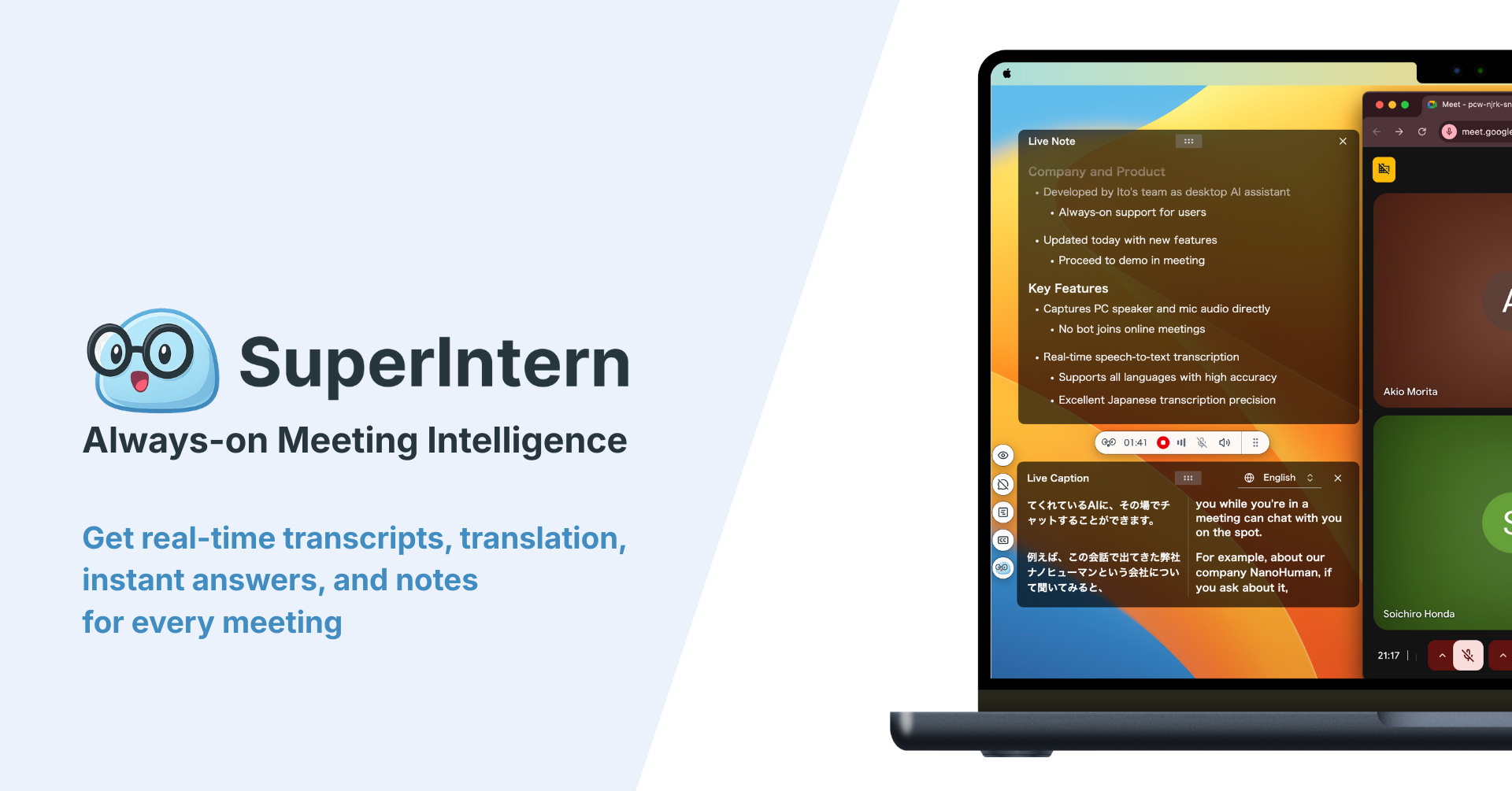
What makes it work for sales:
- Botless operation: Runs locally on Mac, capturing audio from your speakers and microphone without any visible bot appearing in the meeting. Your prospect never knows you're using translation assistance.
- 50+ language support: Covers virtually any language combination you'll encounter in global sales.
- Platform independence: Works across Zoom, Teams, Google Meet, Webex—or even in-person meetings. One tool, every scenario.
- Real-time structured notes: Not just translation, but intelligent meeting summaries that update as the conversation progresses.
- Custom dictionary: Register your company's product names, competitor names, and industry terminology for accurate translation.
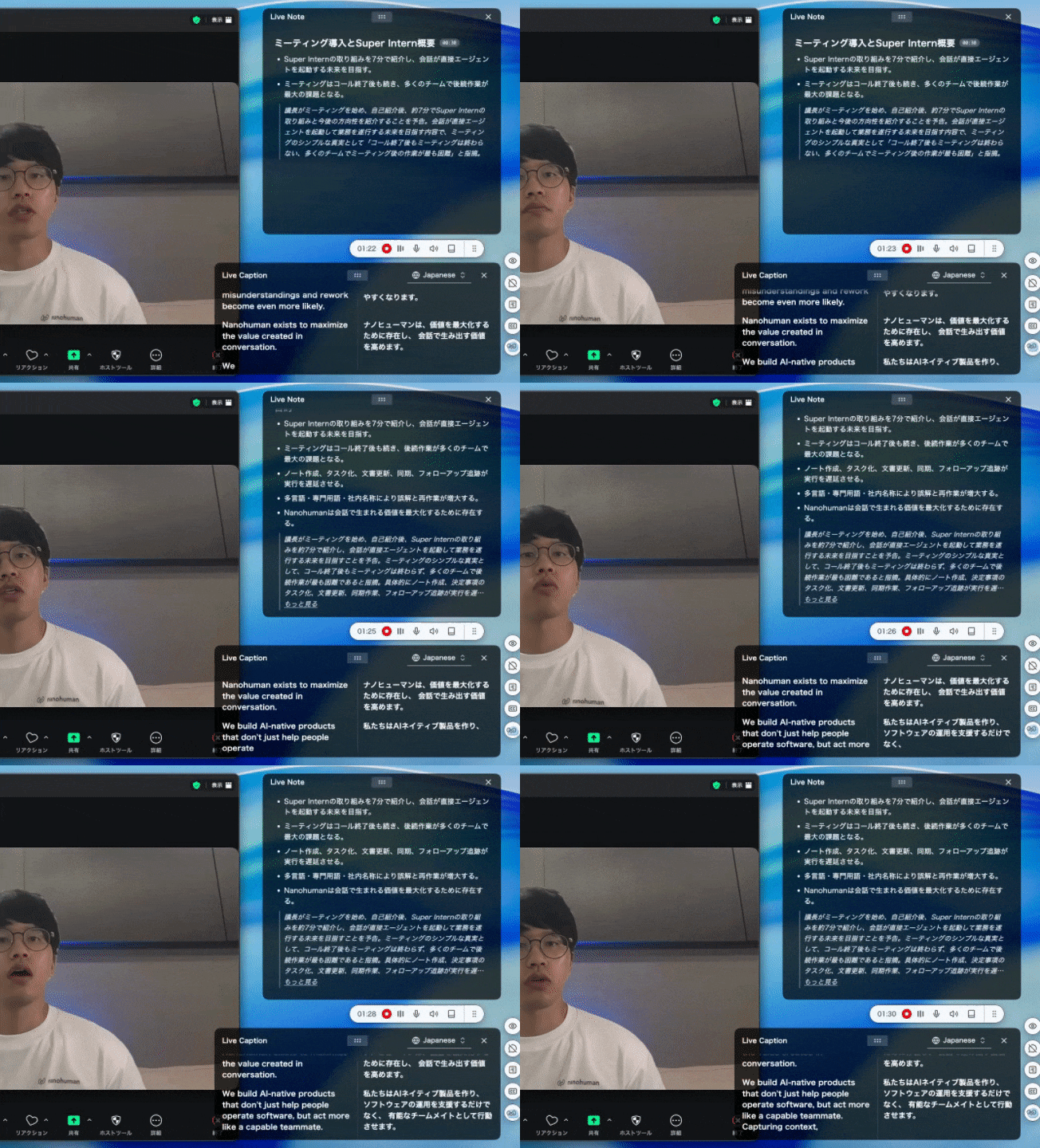
For sales professionals navigating multilingual deals, this combination of features addresses the full workflow—from understanding prospects in real time to creating documentation afterward.
You can start using SuperIntern free, without a credit card.
👉 Try SuperIntern for International Sales
The Competitive Reality
Global sales is no longer optional for ambitious companies. Markets beyond your home territory represent enormous opportunity—but only if you can communicate effectively with prospects in those markets.
The traditional approach—building teams with native speakers for each region—remains valid but doesn't scale for every organization. Meanwhile, language barriers cost real money: lost deals, extended sales cycles, misaligned solutions, and damaged relationships.
Real-time translation technology has matured to the point where it genuinely solves these problems. Sales professionals who adopt these tools gain tangible advantages: more markets, faster deals, better client relationships, and more accurate execution.
The question isn't whether to use translation technology—it's which solution fits your specific needs.
If your international sales involve:
- Calls across multiple platforms (Zoom, Teams, Meet)
- Sensitive client conversations where visible bots are inappropriate
- Need for both live translation and meeting documentation
- Technical or industry-specific vocabulary
...then consider giving SuperIntern a try.
👉 Start Free — No Credit Card Required
This article was prepared by NanoHuman Inc. based on publicly available research and our experience building AI communication tools. SuperIntern is our product, and while we've attempted to present its capabilities objectively, readers should evaluate all tools based on their specific requirements.