
Overcoming Language Barriers in Your Global Team Meetings

If you've ever sat in a meeting where half the participants seemed lost, or watched a promising discussion stall because someone couldn't express their idea clearly in English, you know how frustrating language barriers can be.
You're not alone. According to research from the Harvard Business Review, 75% of cross-border business teams face communication challenges due to language differences.
The costs aren't just in wasted meeting time. Language barriers erode trust, exclude valuable perspectives, and create invisible walls between team members who should be collaborating freely. Research from Tenzer, Pudelko, and Harzing shows that language barriers can significantly hinder trust formation in multinational teams.
But here's the encouraging part: overcoming language barriers in meetings has never been more achievable. The combination of practical communication strategies and rapidly advancing AI translation technology means your global team can communicate more effectively than ever before.
This guide explores both sides of the solution—what you can do today to improve multilingual communication, and how the right tools can eliminate barriers your team may have accepted as inevitable.
⚠️ This article is an independent summary by NanoHuman Inc. based on publicly available information and research as of January 2026.
Why Language Barriers Cost More Than You Think
The obvious problem with language barriers is misunderstanding. Someone says one thing; another person hears something different. Projects go sideways. Deadlines slip.
But the hidden costs run deeper.
Silent disengagement. When non-native speakers struggle to follow fast-paced discussions, they often stop trying. Research has documented how less proficient speakers of a company's official language feel "restricted and reduced" and tend to cope by avoiding meetings entirely. You lose their insights, creativity, and engagement—not because they lack good ideas, but because expressing those ideas feels too difficult.
Decision-making bottlenecks. Important decisions get delayed because key stakeholders couldn't fully participate in the discussion. Or worse, decisions get made without full input, leading to problems that surface weeks or months later.
Relationship friction. Language barriers don't just affect information transfer—they affect how people feel about each other. Misunderstandings can feel like disagreements. Silence can feel like disengagement. Over time, this erodes the trust that global teams depend on.
Meeting multiplication. When communication is unclear, teams compensate with more meetings, more follow-ups, more written clarifications. A study by the Project Management Institute found that 56% of project failures are attributed to poor communication—and language barriers are a significant contributor.
The question isn't whether to address language barriers. It's how.
Strategy 1: Adapt Your Communication Style
Before reaching for technology, consider how meeting leaders and participants can adjust their communication to be more accessible across languages.
Slow Down and Simplify
Native speakers often underestimate how quickly they talk and how much idiom they use. Phrases like "let's circle back," "move the needle," or "hit the ground running" can confuse non-native speakers—or worse, be taken literally.
Practical adjustments:
- Speak at a measured pace, especially when presenting
- Use short, direct sentences rather than complex constructions
- Replace idioms with clear statements: "let's discuss this again later" instead of "let's circle back"
- Pause after important points to allow processing time
Use Visual Support
Supplement spoken words with visual aids whenever possible:
- Screen-share documents, diagrams, or bullet points during discussions
- Use chat to spell out key terms, names, or numbers
- Follow up meetings with written summaries
Visual information provides a safety net when spoken words are missed or misunderstood.
Create Space for Participation
Non-native speakers often need more processing time to formulate responses. Meeting structures that favor quick, spontaneous contributions inadvertently exclude them.
Try these approaches:
- Share agendas and discussion topics in advance so participants can prepare thoughts in their native language first
- Explicitly invite quieter participants to contribute: "Yuki, we'd love your perspective on this"
- Use asynchronous input for complex topics—gather written thoughts before or after the meeting
- Consider rotating meeting times if team members span multiple time zones
Establish Ground Rules
Make inclusive communication a team norm:
- Encourage everyone to ask for clarification without embarrassment
- Agree that slowing down for clarity is valuable, not inefficient
- Consider designating a "communication check" role that can pause discussions when someone seems lost
These strategies help—but they have limits. Adapting your communication style reduces barriers; it doesn't eliminate them. For that, you need tools that can bridge languages in real time.
Strategy 2: Leverage AI-Powered Translation Tools
The most significant advancement in overcoming language barriers has been the maturation of AI translation technology. What was experimental five years ago is now production-ready for everyday business use.
Today's tools can provide real-time subtitles, live translation, and even voice interpretation—allowing every meeting participant to follow along in their preferred language, without interrupting the natural flow of conversation.
How Modern Meeting Translation Works
There are several approaches to real-time meeting translation:
Platform-native features: Zoom, Microsoft Teams, and Google Meet all now offer built-in translated captions. These work well if your entire team uses a single platform, though accuracy and language support vary.
Bot-based translation services: Some tools join your meeting as a participant to capture and translate audio. While functional, this approach can feel intrusive—especially in client meetings or sensitive discussions where an unfamiliar "Notetaker" in the participant list changes the dynamic.
Desktop-based, botless translation: A newer category of tools captures audio directly from your computer without joining the meeting. These work across any platform and remain invisible to other participants—ideal for external meetings where discretion matters.
What to Look for in a Translation Tool
Not all translation tools are created equal. When evaluating options for your team, consider:
Translation accuracy: Business communication demands higher accuracy than casual conversation. Look for tools specifically optimized for professional contexts, with custom dictionary features for company-specific terminology.
Platform flexibility: If your team uses multiple meeting platforms—or meets frequently with external parties who use different tools—a platform-agnostic solution provides the most value.
Bot presence: For internal meetings, a bot may be acceptable. For client calls, 1-on-1s, or sensitive discussions, botless operation may be essential.
Language breadth: Ensure the tool supports the specific language pairs your team needs. Some tools excel at major languages but struggle with less common pairs.
Additional features: Some tools combine translation with meeting notes, transcripts, or summaries—consolidating multiple capabilities into a single workflow.
SuperIntern: A Purpose-Built Solution for Global Teams
SuperIntern was designed specifically to help global teams overcome language barriers in meetings—whether those meetings happen on Zoom, Teams, Meet, or even in person.
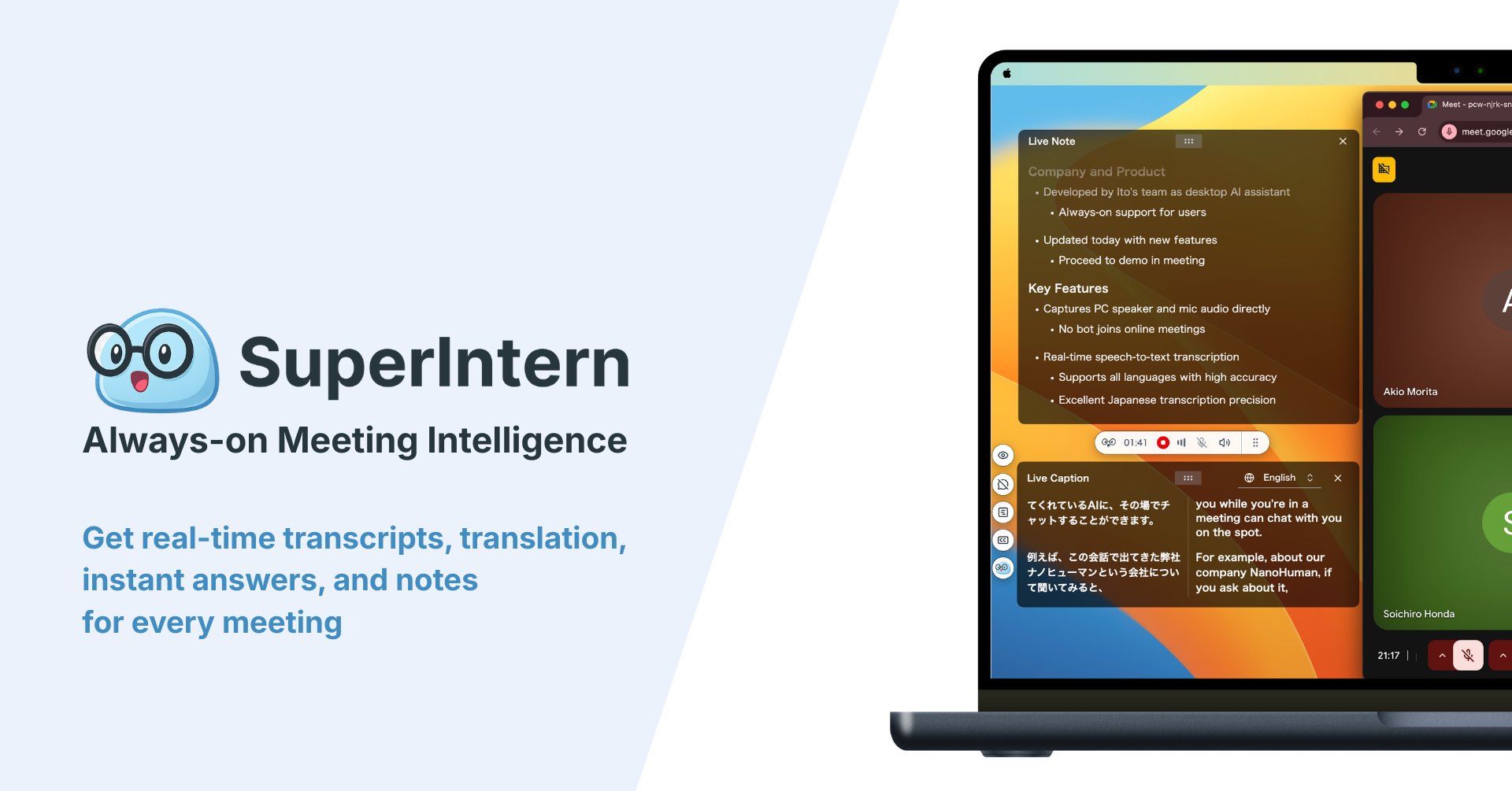
Key capabilities:
- Real-time translation in 50+ languages — optimized for business contexts with high accuracy even for technical discussions
- Botless operation — captures audio directly from your Mac's speakers and microphone; no participant appears in your meeting
- Platform-agnostic — the same experience whether you're on Zoom, Teams, Meet, Webex, or any other platform
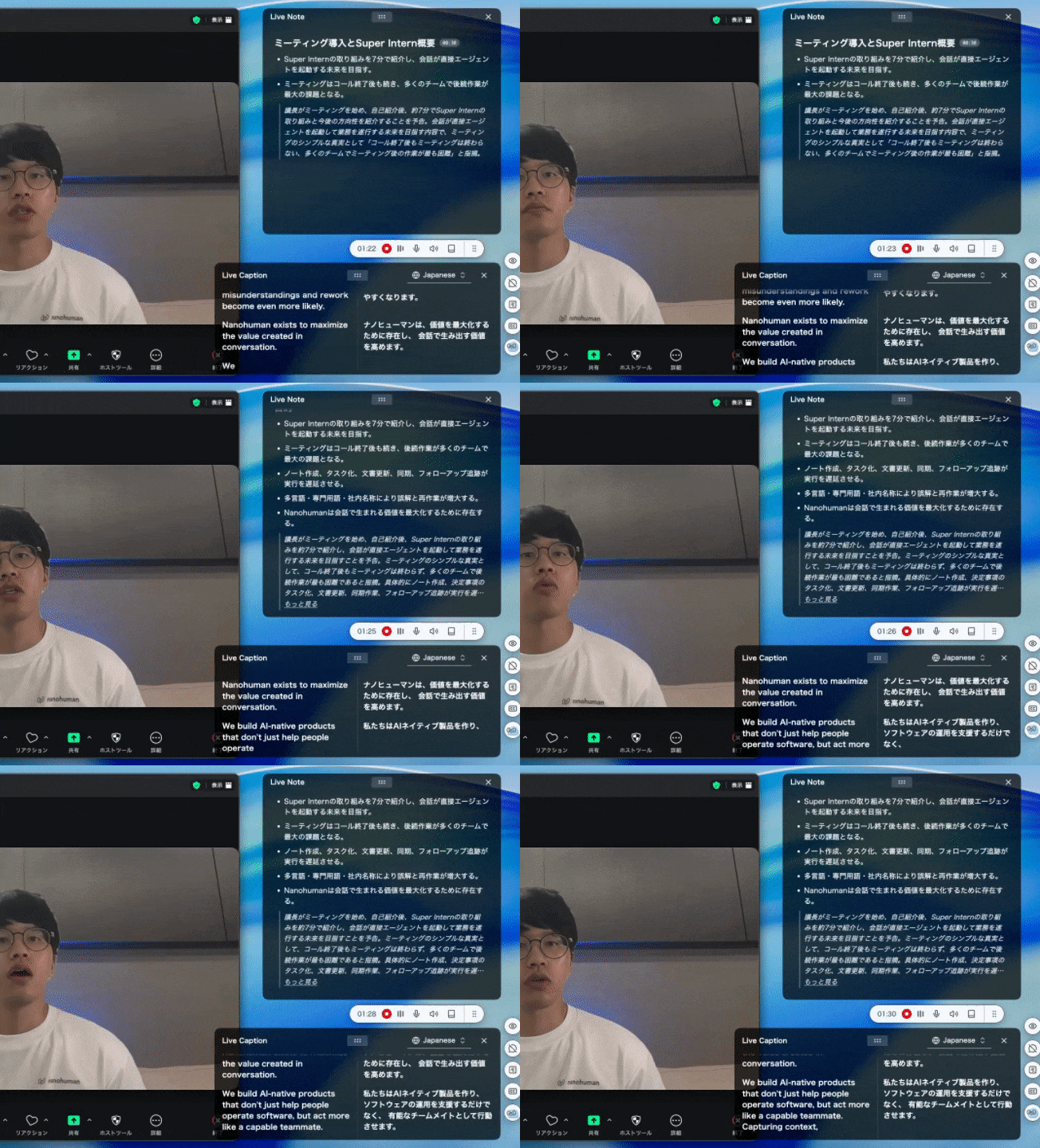
- Real-time structured notes (Live Note) — not just translation, but AI-organized meeting notes that update as the conversation happens—always in your preferred language
- Custom dictionary — register company names, product names, and industry terminology to improve accuracy on the terms that matter most
- Flexible language settings — set different languages for subtitles vs. summaries (e.g., hear Japanese, read English subtitles, get summary in English)
Why teams choose SuperIntern:
The combination of botless operation and platform independence solves the two most common frustrations with translation tools: the awkwardness of bots in external meetings, and the inconsistency of having different solutions for different platforms.
The Live Note feature is particularly valuable for non-native speakers. Even when you can't catch every word in a fast-moving discussion, you can always glance at the real-time summary in your strongest language to stay caught up. This means you're never left behind wondering what was just decided—you can follow the meeting's key points as they happen, in the language you think in.
For global teams where members regularly join meetings in multiple languages, SuperIntern provides a consistent, high-accuracy translation experience that works regardless of meeting context—without changing how anyone else experiences the call.
Current limitations:
- Currently available for Mac; Windows version waitlist is now open — Join the Windows Waitlist
- Team and enterprise pricing requires contacting NanoHuman Inc. directly
👉 Try SuperIntern Free — No Credit Card Required
Strategy 3: Build Translation Into Your Meeting Culture
Having tools available isn't enough. The most successful global teams actively normalize translation as part of how they work.
Make Translation Standard, Not Special
When translation tools are treated as accommodations for "non-native speakers," they carry an implicit stigma. Instead, position translation as a standard part of professional collaboration—something that helps everyone communicate better.
Encourage all team members to try translation tools, not just those who need them most. When native speakers experience the cognitive load of following a meeting in translation, they develop empathy for colleagues who do this constantly.
Design Meetings for Multilingual Participation
Even with excellent translation, some meeting formats work better for multilingual teams than others:
- Longer meetings with breaks give translation-reliant participants more time to process
- Smaller groups allow more speaking time per person and reduce cross-talk that confuses translation
- Written agendas and follow-ups create reference points that don't depend on real-time language processing
- Recorded meetings with transcripts allow participants to review discussions in their own time and language
Invest in Both Technology and Skills
Translation tools and language training aren't either/or choices. The most effective approach combines both:
- Use translation tools for immediate barrier removal—everyone can participate today
- Support language learning for long-term development—team members can grow their skills over time
- Consider that confidence in speaking English (or any lingua franca) often matters more than perfection
Putting It Together: A Practical Framework
Here's a framework for systematically reducing language barriers in your team's meetings:
Immediate actions (this week):
- Evaluate your meeting platforms' built-in translation features
- Trial a desktop-based translation tool like SuperIntern with a free account
- Discuss communication norms with your team—slower pace, clearer language, explicit invitations to participate
Short-term improvements (this month):
- Identify which meetings would benefit most from translation support
- Establish translation as a standard practice, not an accommodation
- Gather feedback from non-native speakers on what helps them participate more fully
Ongoing development:
- Review and improve your custom dictionary with company-specific terms
- Consider whether language training would complement translation tools
- Regularly check in with team members on communication quality
The Competitive Advantage of True Multilingual Collaboration
Organizations that genuinely solve language barriers—not just tolerate them—unlock significant advantages:
Faster global expansion. Teams that can collaborate effectively across languages can integrate international hires, partners, and clients more quickly.
Better decisions. When everyone can fully participate, you get more diverse perspectives and catch potential problems earlier.
Stronger relationships. Removing language friction allows personal connections to form more naturally across cultural boundaries.
Broader talent access. When language proficiency isn't a barrier to participation, you can hire the best people regardless of their English fluency.
The technology to overcome language barriers now exists. The question is whether your team will adopt it—and build the communication culture to make it effective.
Getting Started
If language barriers are affecting your team's meetings, the best first step is simply to try a modern translation tool and see the difference it makes.
SuperIntern offers a free trial with no credit card required. In a few minutes, you can be running real-time translation in your next meeting—on any platform, without any bot joining your call.
Whatever approach you choose, the goal is the same: meetings where everyone can contribute their best thinking, regardless of their native language. That's not just good for inclusion—it's good for business.