
Why Your Next Investor Pitch Needs Real-Time Translation and Live Notes

You've built something worth funding. Your product has traction. Your metrics are strong. But when you sit down with that investor from Singapore, London, or San Francisco, something gets lost between your slides and their understanding.
It's not your idea. It's not your numbers. It's the invisible wall of language—and the cognitive load of communicating in a language that isn't your first.
If you're a founder preparing to pitch international investors, this guide is for you. We'll cover practical strategies for communicating effectively across language barriers, and introduce tools that can give you an unfair advantage in high-stakes conversations.
⚠️ This article is an independent summary by NanoHuman Inc. based on publicly available research and best practices as of January 2026.
The Hidden Challenge of Cross-Border Fundraising
Cross-border investment activity continues to grow. According to UNCTAD, global foreign investment rose 14% in 2025, with capital increasingly flowing across borders to reach promising startups worldwide.
But with this opportunity comes a challenge that rarely makes it into fundraising guides: communication friction.
When you pitch in your second (or third) language, you're not just translating words. You're:
- Processing complex questions in real time
- Formulating nuanced answers under pressure
- Monitoring your pronunciation and grammar while trying to appear confident
- Missing subtle cues that would be obvious in your native language
Research on multilingual communication in business settings shows this cognitive load is real. Non-native speakers often feel what researchers describe as being unable to fully express themselves—not because they lack ideas, but because expressing those ideas in another language requires significantly more mental effort.
And investor pitches are already high-pressure situations. Add language barriers, and even founders with excellent English skills can find themselves underperforming.
What International Investors Actually Care About
Before diving into solutions, let's be clear about what investors evaluate during a pitch. Understanding this helps you focus your communication energy where it matters most.
The Story, Not Perfect Grammar
Top investors consistently emphasize that they invest in people, not just companies. What they're looking for is:
- A coherent narrative backed by data
- Authentic communication that shows genuine belief in your vision
- Specific facts that demonstrate mastery of your market and product
- The ability to adapt and answer questions directly
Notice what's not on that list: flawless pronunciation or native-level idiom usage.
As one investor guide puts it: telling a story from start to finish is crucial, delivered in a clear and concise voice. Grammar mistakes are forgiven when the speaker is clearly an expert and genuinely passionate about their work.
Time Is Compressed
Investors now take just three minutes to decide whether they're interested in a pitch deck. In live meetings, first impressions form even faster.
This means your opening moments are critical. You don't have time to "warm up" linguistically. You need to hook attention immediately—and maintain it through a conversation that may go in unexpected directions.
Questions Are the Real Test
Many founders over-prepare their initial presentation and under-prepare for Q&A. But experienced investors often say: the most persuasive presentations are conversations.
When investors ask questions, they want direct answers—not deferrals to a later slide. Being able to engage naturally with questions, pivot your explanation, and demonstrate deep knowledge in real time is often more persuasive than a polished deck.
This is precisely where language barriers hurt most. Impromptu responses require faster processing than prepared remarks.
Practical Strategies for Pitching Across Languages
Whether or not you use technology, these strategies will improve your cross-border pitch effectiveness.
1. Over-Prepare, Then Simplify
Research consistently shows that non-native speakers benefit from preparing significantly more than their native-speaking counterparts. But the goal isn't to memorize a script—it's to achieve what experts call "overlearning," where your material becomes so familiar that you can focus on delivery rather than recall.
Then simplify. Use shorter sentences. Avoid idioms. State key numbers and facts clearly. Your goal is communication, not demonstrating vocabulary.
2. Embrace the Pause
When you lose your place or need a moment to process a question, silence feels terrifying. But audiences are patient. Research suggests counting to five mentally when you feel lost—you'll likely find your place before you reach three.
The pause that feels like an eternity to you barely registers for your audience. And a thoughtful pause before answering often conveys confidence, not confusion.
3. Lean on Visuals
If you're not fully confident in your spoken delivery, it's perfectly acceptable to include more text on slides than conventional wisdom suggests—especially when presenting to international investors who may also be processing your words in a non-native language.
Charts, diagrams, and key numbers on screen provide multiple channels for your message. They're especially valuable for technical concepts or financial details where precision matters.
4. Know Your Investor
Every investor is different. Some focus on financials; others want the big vision. Do your homework: research their portfolio, their stated interests, their communication style.
Then tailor your pitch accordingly. The same core story can be framed differently depending on who's in the room. This customization also helps you anticipate likely questions.
5. Build the Relationship Over Time
Investors need months of interaction to build conviction. Even if your English isn't perfect in a first meeting, consistent follow-up, monthly updates, and ongoing communication demonstrate commitment and allow relationships to develop naturally.
A founder who communicates regularly and authentically will outcompete one who only shows up polished for pitch meetings.
Where Real-Time Translation Becomes Your Advantage
Even with excellent preparation, live conversations remain challenging. This is where technology can provide a genuine edge.
The Problem with Traditional Approaches
Historically, founders have had limited options:
Hiring an interpreter — Expensive, creates an awkward three-way dynamic, and often unavailable for the casual coffee meetings where many investor relationships begin.
Relying on your own language skills — Works until it doesn't. Even fluent non-native speakers miss nuances, especially when conversations move fast or involve unfamiliar idioms.
Asking investors to slow down — Reasonable in theory, uncomfortable in practice. It shifts focus to your limitations rather than your strengths.
Real-Time Translation Changes the Equation
Modern AI translation tools—running silently in the background—can provide:
- Live subtitles in your native language for everything the investor says
- Real-time notes that capture key points as they're discussed
- The confidence that comes from knowing you won't miss critical information
This isn't about replacing your English skills. It's about adding a safety net that lets you focus on what matters: telling your story, demonstrating your expertise, and building a relationship.
Why Live Notes Matter as Much as Translation
Translation helps you understand. But live notes help you respond.
During a pitch, you're often juggling multiple threads: the investor's question, your answer, the follow-up point you wanted to make, the objection you should address. In a second language, this cognitive load becomes overwhelming.
Real-time structured notes—organized as the conversation happens—let you glance at a summary of what's been discussed. You can see which points the investor focused on, what questions were asked, and where the conversation is heading. This means:
- You won't forget to address a key concern
- You can reference earlier discussion points naturally
- You'll appear more organized and responsive
For non-native speakers, this is a genuine competitive advantage.
SuperIntern: Built for Cross-Border Conversations
SuperIntern was designed specifically for high-stakes multilingual communication—exactly the kind of conversations that happen when founders pitch international investors.
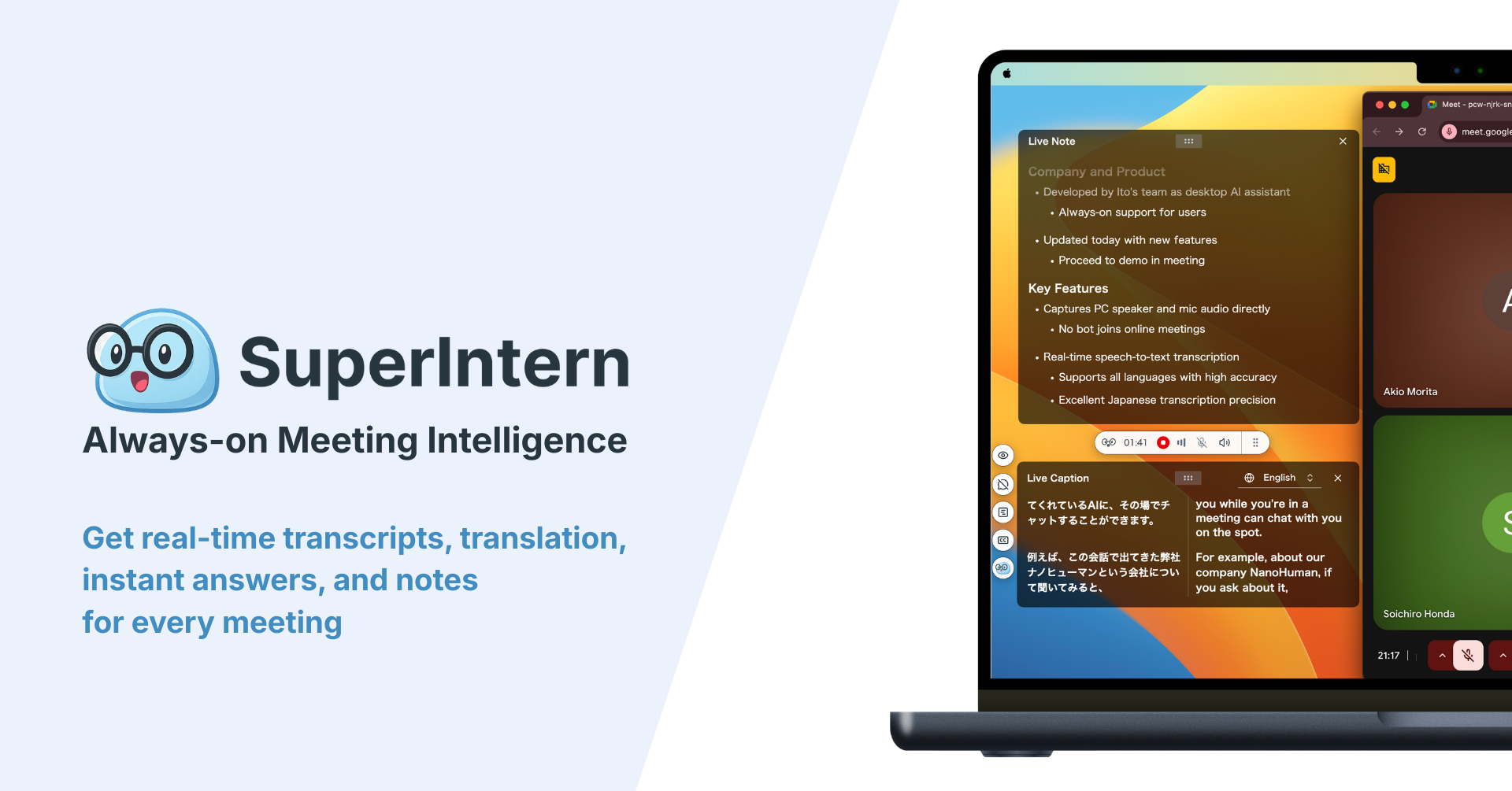
Key capabilities:
- Real-time translation in 50+ languages — optimized for business contexts with high accuracy even for fast-paced discussions
- Botless operation — captures audio directly from your Mac; no visible participant appears in your video call
- Live Note feature — AI-organized meeting notes that update in real time, always in your preferred language
- Custom dictionary — register investor names, fund names, and industry terminology to improve accuracy
- Works everywhere — Zoom, Teams, Meet, or even in-person meetings
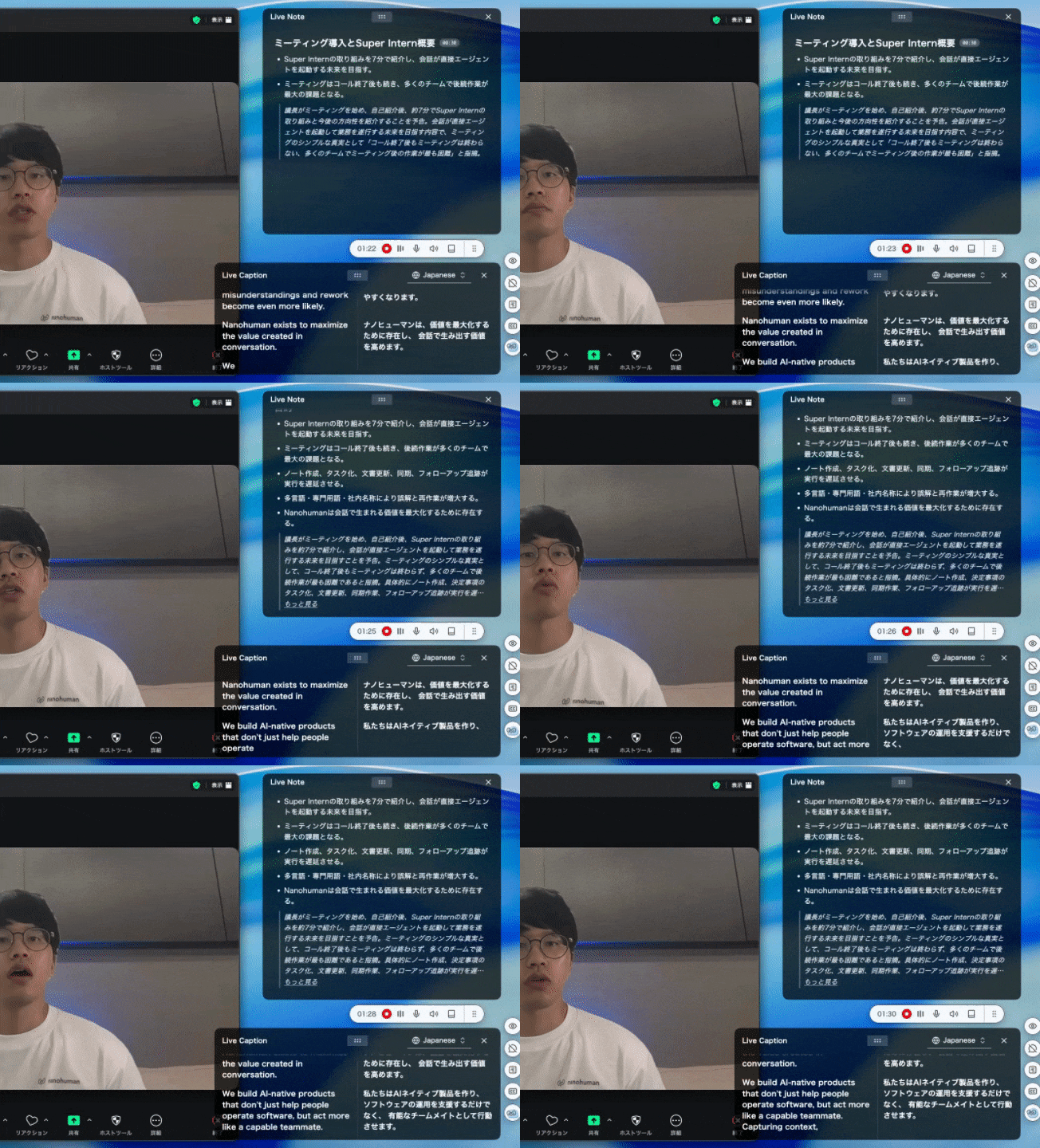
Why founders choose SuperIntern for investor meetings:
The combination of translation and live notes addresses both sides of the communication challenge. You understand everything the investor says—and you have a running summary to help you respond thoughtfully.
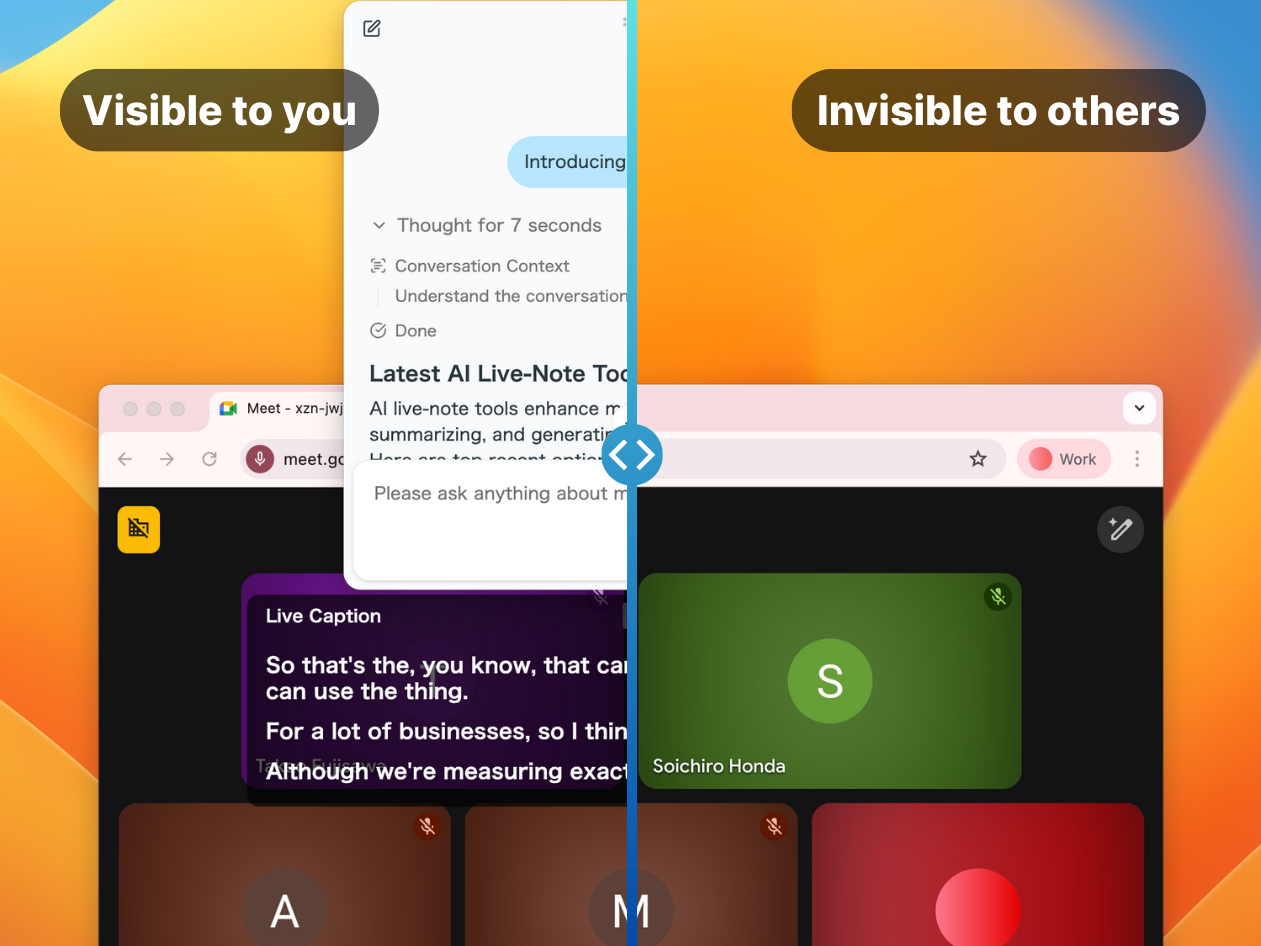
The botless design is particularly important for investor meetings. When you're building a relationship, the last thing you want is an unfamiliar "Notetaker" in the participant list prompting questions about who's listening or recording. SuperIntern runs locally on your device, invisible to the other party.
Current limitations:
- Currently available for Mac; Windows version waitlist is now open — Join the Windows Waitlist
- Team and enterprise pricing requires contacting NanoHuman Inc. directly
👉 Try SuperIntern Free — No Credit Card Required
Preparing for Your Next International Pitch
Here's a practical framework for incorporating these strategies:
Before the Meeting
- Research the investor thoroughly — portfolio companies, stated thesis, communication style
- Over-prepare your core narrative — practice until it feels automatic
- Simplify your language — short sentences, specific facts, minimal idioms
- Set up SuperIntern — configure your language pair, add investor and fund names to your custom dictionary
During the Meeting
- Hook them early — lead with what makes you compelling, not pleasantries
- Use pauses strategically — a moment of silence is fine; panic is not
- Glance at live notes when needed — they're your cognitive support system
- Engage with questions directly — don't defer to later slides
After the Meeting
- Review your notes — SuperIntern's summary captures what was discussed, in your language
- Follow up promptly — thank them, answer lingering questions, share additional materials
- Build the relationship — regular updates create trust over time
Overcoming Language Barriers Is a Competitive Advantage
Here's the encouraging truth: investors know that the best founders aren't always the most polished presenters. They're looking for authentic expertise, genuine passion, and the ability to build something valuable.
If you can overcome language barriers in meetings—whether through preparation, practice, or smart use of technology—you demonstrate exactly the kind of resourcefulness investors want to fund.
The technology to communicate effectively across languages now exists. The question is whether you'll use it to level the playing field—and show international investors what you're truly capable of.
Your next pitch could be the one that changes everything. Make sure language isn't what holds you back.